







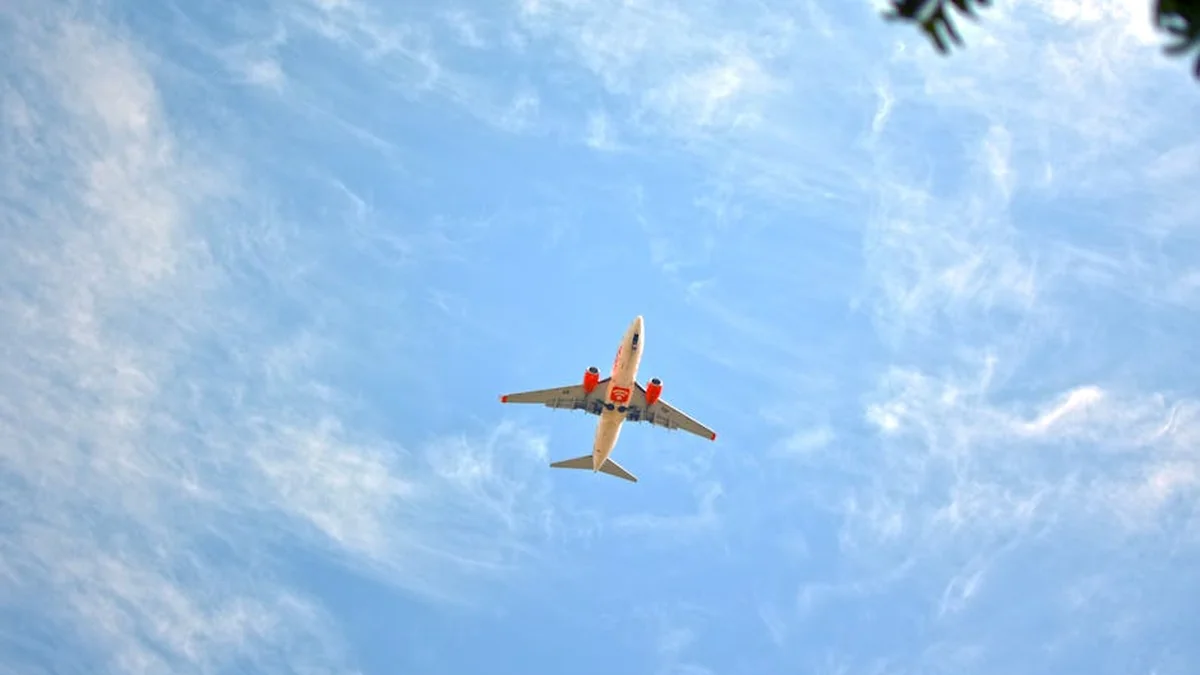
Bidzina Ivanishvili 16.04.2026 Airspace over Abastumani closed: observatory needs or Ivanishvili’s whim? JAMnews Tbilisi Share Share Closure of airspace over Abastumani From 16 April 2026, the Georgian government will change the rules governing airspace over the town of Abastumani, closing a zone used for international flight routes. The move will partially alter routes for passenger and cargo planes travelling between Europe and Asia, forcing aircraft to bypass the area.
The government says the decision is needed to support scientific and astronomical observations, as an observatory is located in Abastumani. However, an in-depth investigation by Radio Free Europe/Radio Liberty raises questions about whether the decision also reflects the personal interests of Bidzina Ivanishvili. In recent years, Abastumani has become the main residence of Georgia’s informal leader and his family.
_______________________________________________________ An investigation by Radio Free Europe/Radio Liberty found that the Georgian government created a new restricted-access zone called “Abastumani-2” under a decree adopted in February. The new rules will take effect on 16 April and will close airspace with a diameter of about 52 kilometres over the town of Abastumani. This is an almost unprecedented move for Georgia.
The zone stretches from the Turkish-Georgian border and covers Abastumani, the Adigeni region and parts of southern Georgia. As a result, manoeuvring space will shrink significantly in an area where flights already operate under difficult conditions due to the terrain. The government says the restriction is based on a request from the astrophysical observatory in Abastumani.
Observatory director Alexander Tevzadze told Radio Free Europe/Radio Liberty that aircraft trails interfere with night-time observations and that the institution has called for broader restrictions for many years. He says the issue became even more pressing after the installation of a new telescope. However, the investigation focuses on another aspect.
Sources from the aviation sector and government bodies told Radio Free Europe/Radio Liberty that the decision is not only about science. They say the closure of the airspace over Abastumani reflects “Bidzina Ivanishvili’s whim” rather than a scientific necessity. Ivanishvili has owned a residence in Abastumani since 2020.
Since 2018, people linked to his family and inner circle have been buying land and property in the resort town. Residential houses, a hotel under construction and a helipad have since appeared there. State investment in the region has also increased after Ivanishvili’s arrival.
According to Transparency International Georgia, the government spent about 250 million lari on various projects in Abastumani between 2018 and 2022. During that time, authorities altered a road construction project and built a bypass road, which caused environmental concerns. The issue of restricting airspace over Abastumani dates back to 2019.
At that time, authorities temporarily closed a small eight-kilometre zone at the observatory’s request. The restriction later became almost permanent, and officials created the “Abastumani-1” zone. Civilian flights were almost entirely banned in that area.
However, one exception remained: aircraft landing in or taking off from the zone were allowed to operate. According to the investigation, the only helipad in that zone belongs to Bidzina Ivanishvili. The new restrictions, which cover a much larger area, now also apply to international routes.
The new zone affects at least three key air corridors, including M747 and N644, which connect Europe, Asia, the Middle East and the Caucasus. Airlines such as Lufthansa, Turkish Airlines, Emirates and Qatar Airways use these routes. The change is particularly significant because the Caucasus has become one of the main air corridors between Europe and Asia.
Restrictions on Russian and partly Iranian airspace have increased traffic in the region. Official data show that traffic over Georgia has risen by 52% since 2019. In 2025 alone, more than 305,000 flights crossed the country’s airspace.
For Georgia, this is not just a matter of safety. Transit flights are a significant source of budget revenue. Official figures show that Georgia earned 120 million lari from them in 2024.
Aviation industry representatives say the new restrictions will lengthen routes, increase fuel costs and reduce manoeuvring space. They warn that redirecting flights northwards will worsen congestion in an already challenging section of airspace shaped by the Caucasus terrain. This could lead to higher costs for airlines, delays and additional air traffic management risks.
The European aviation body Eurocontrol told Radio Free Europe/Radio Liberty that Georgia began informing them about the changes in 2023, and that the planned restrictions are already reflected in route planning. According to the organisation, the changes will extend some flight routes by about 10 kilometres. How does oligarch Bidzina Ivanishvili de facto rule Georgia?
The oligarch’s hometown – the founding legend of the Georgian Dream Centuries old trees – the billionaire’s latest temptation The “scientific” argument for closing the airspace also raises questions. The observatory’s director says similar practices exist abroad, although he could not name specific examples in an interview. Journalists from Radio Free Europe/Radio Liberty also failed to find cases where airspace over a civilian site was restricted on such a scale.
Publicly available information suggests that leading observatories usually limit low-altitude flights, while modern methods filter out aircraft trails. Astrophotographer David Dvali makes a similar point. He says aircraft do interfere with astronomical observations, but not to the extent that would justify a large-scale ban on international transit flights.
In his view, the observatory’s needs may serve more as a convenient argument than the r
Topics: #airspace #over #abastumani